Atlantic spotted dolphin - Stenella frontalis
Taxonomy & Nomenclature
Physical Description / Field Identification
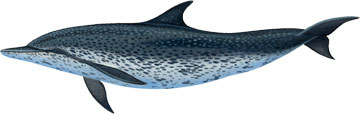
Atlantic spotted dolphins begin life with unspotted background coloration. Young animals look much like slender bottlenose dolphins, with a dark cape, light gray sides, spinal blaze (variable in its development), and white belly. Development of larger spots on both dorsal and ventral surfaces progresses as the animal ages; some individuals become so heavily spotted that the cape margin and spinal blaze are obscured. However, in some populations, adults are essentially unspotted (these are generally in offshore areas).
The Atlantic spotted dolphin in many ways resembles the Indo-Pacific bottlenose dolphin more than it does the pantropical spotted dolphin. In body shape, it is intermediate between the two, with a moderately long but rather chunky beak. There is a distinct crease between the melon and beak and 30-42 teeth in each tooth row.
Adults are up to 2.3 m long and 143 kg in weight. Newborn Atlantic spotted dolphins are 0.8-1.2 m long. Can be Confused With
Atlantic spotted dolphins can be most easily confused with bottlenose dolphins (although they do not overlap in distribution with the Indo-Pacific species). The differences in size and robustness are good clues, but may require a trained eye to distinguish. Heavy spotting is a good characteristic for Atlantic spotted dolphins; however, some may be nearly unspotted and some bottlenose dolphins may have spotting and blotches on the belly and sides. Pantropical spotted dolphins also may be difficult to distinguish, but attention to body robustness, beak and dorsal fin shape, and color pattern differences will allow them to be separated. Distribution
This species is found only in the tropical/warm temperate waters of the Atlantic Ocean, from southern Brazil to New England in the west, and to the coast of Africa in the east (the exact limits off West Africa are not well known). Their tropical to warm temperate distribution is mostly over the offshore continental shelf, but they also inhabit some deep oceanic waters.
Ecology and Behavior
The Atlantic spotted dolphin inhabits shelf/slope waters. Small to moderate groups, generally of less than 50 individuals, are characteristic of the Atlantic spotted dolphin. Coastal groups usually consist of 5-15 animals. These are acrobatic animals and they are known to be avid bowriders. Studies of Atlantic spotted dolphins off the Bahamas, which allow people to swim with them, show that these animals have a fluid group structure, like that of bottlenose and other small dolphins. There is not much known of the species' life history, but tropical populations would be expected to have a protracted breeding season. Feeding and Prey
Atlantic spotted dolphin diets are dominated by: Fish>squid>other invertebrates
A wide variety of epi- and mesopelagic fishes and squids, as well as benthic invertebrates, are taken by this species. They feed by seizing prey species, such as fish (Peprilus paru, Isopisthus parvipinnis, Raneya fluminensis, Orthopristis ruber, Cynoscion guatucupa, Ariosoma opithophthalma, Trichiurus lepturus) and cephalopods (Loligo plei, Loligo sanpaulensis). Threats and Status
The main threat for Atlantic spotted dolphins is fisheries bycatch. The IUCN lists this species is “data deficient”, in that too little is known to evaluate its conservation status. The United States government does not list the Atlantic spotted dolphin as threatened or endangered. Incidental catches in fisheries are known for several areas of the range (Brazil, the Caribbean, off the east coast of the United States, and in Mauritania). No direct killing is known, other than occasional catches in the Caribbean dolphin fisheries. Based on two 1998 surveys, the United States National Marine Fisheries Service (NMFS) estimated the population of all spotted dolphins in the western North Atlantic (including S. frontalis and S. attenuata) to be 52,279 (CV=0.87). Data from surveys between 1991 and 1994 were used to estimate the northern Gulf of Mexico Stock at 32,123 (CV=0.44), although NMFS considers this an underestimate due to survey limitations. Links
References
Herzing, D.L. 1997. The life history of free-ranging Atlantic spotted dolphins (Stenella frontalis) Age classes, color phases, and female reproduction. Marine Mammal Science 13:576-595.
Perrin, W.F. 2002. Stenella frontalis. Mammalian Species 702:1-6.
Perrin, W.F. 2002. Atlantic spotted dolphin Stenella frontalis. pp. 49-51 in W.F. Perrin, B. Würsig and J.G.M. Thewissen, eds. Encyclopedia of marine mammals. Academic Press.
Perrin, W.F., E.D. Mitchell, J.G. Mead, D.K. Caldwell, M.C. Caldwell, P.J.H. van Bree and W.H. Dawbin. 1987. Revision of the spotted dolphins, Stenella spp. Marine Mammal Science 3:99-170.
Perrin, W.F., D.K. Caldwell and M.C. Caldwell. 1994. Atlantic spotted dolphin Stenella frontalis (G. Cuvier, 1829). pp. 173-190 in S.H. Ridgway and R. Harrison, eds. Handbook of marine mammals, Volume 5 The first book of dolphins. Academic Press.
|
|
| ITIS TSN | 552460 |
|
Status - ESA, U.S. FWS
|
| - |
|
Status - Red List, IUCN
|
| LC (Global) |
| #records (spatial) | 14,444 |
| #records (non-spatial) | 15 |
| #datasets | 168 |
| Year | 1905 - 2024 |
| Latitude | -23.65 - 49.20 |
| Longitude | -96.98 - 8.72 |
| See metadata in static HTML |
|


