Laysan albatross - Phoebastria immutabilis
Taxonomy & Nomenclature
Physical Description / Field Identification
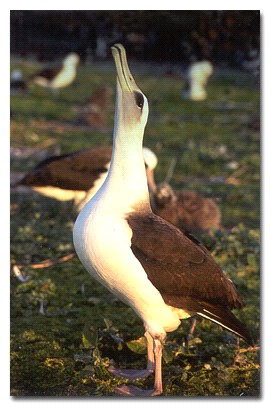
Phoebastria immutabilis weigh approximately 3.2 kilograms, with males weighing about 10% more than females. They have a wingspan of approximately 2.1 meters, and are approximately 0.8 meters in body length. Laysan albatross have a white head, body, rump and undertail coverts; their back and upperwings are black. There is also a dark patch surrounding the eye. Bill color varies from gray to yellow with a dark tip. Feet are pinkish. Adult males and females have similar coloration, and juveniles are the same in appearance.
The simplest identifier for Laysan albatross in the field is their large wingspan (large for seabirds, but small for albatross species generally). There is a narrow white U-shaped area between the dark sections of the rump and the tail. Other identifiable features include: the characteristic white head/torso, the black wings, and the unique underwing pattern of black margins and irregular streaks on the coverts. Can be Confused With
P. immutabilis may be confused with its congener (included in genus with the Laysan), the waved albatross P. irrorata. It can be distinguished easily, however, because of the dusky chest, yellow bill, and blue feet of the waved albatross. The Laysan albatross is discernible from the adult short-tailed albatross (P. albatrus) by the short-tail’s larger size, white underwings, and yellow wash on the back/neck plumage. Additionally, P. immutabilis can be separated from other species of albatross because of its unique underwing patterns. Distribution
Laysan albatrosses are cosmopolitan, but breed mostly on the northwestern Hawaiian Archipelago and off Baja California. They arrive at their nesting sites by the end of October, and then incubate and brood chicks from November until February. Adults continue to provision their chicks from March until June. These seabirds spend the non-breeding season in the North Pacific Ocean and the Bering Sea (30-60° latitude). During the non-breeding season (July to November) this species disperses throughout the North Pacific Ocean (30-60° latitude), and enters the Bering Sea. Ecology and Behavior
The Laysan albatross is an open ocean species, coming to land exclusively to breed. Laysan albatross are quiet and solitary at sea, though large flocks (hundreds of birds) occasionally form to exploit fish discards from factory trawlers. Noisy in groups at sea, with groaning or squealing noises and bill-snapping. Feeding and Prey
Laysan albatrosses have a broad diet dominated by: squid > fish > crustaceans. Mainly, they consume neon-flying squid (Ommastrephes bartrami), fish (myctophids, saury), and invertebrates (pelagic barnacles, gelatinous zooplankton).
Laysan albatrosses feed by seizing prey at the surface or shallow diving, though they do not usually submerge fully. They are known to follow and otherwise aggregate at ships and consume fisheries discards. Thus, these albatrosses often scavenge large squid and fish, as well as mammals and seabirds.
Prey species include:
Fish: Brama japonica, Ceratoscopelus sp., Cololabis saira, Coryphaenoides sp., Diaphus gigas, Diaphus tetha, Electrona risso, Diretmus argenteus, Ichthyococus sp., Lampanyctus jordani, Lampanyctus sp., Lampanyctus ritteri, Notoscopelas japonicus, Prionace glauca, Sagamichthys abei, Symbolophorus californiense, Unidentified Moridae, Unidentified Myctophidae.
Cephalopods: Architruthis sp., Berryteuthis anonychus, Chiroteuthis calyx, Galioteuthis phyllura, Galioteuthis sp., Gonatus sp., Histioteuthis dofleini, Histioteuthis sp., Leachia dislocata, Megalocranchia sp., Octopoteuthis deletron, Octopoteuthis sp., Ocythoe tuberculata, Ommastrephes bartrami, Onychoteuthis borealijaponicus, Unidentified Cephalopoda, Unidentified Octopotheuthidae, Unidentified Ommastrephidae, Unidentified Onychoteuthidae, Unidentified Teuthoidea, Taonius pavo, Taonius sp..
Other invertebrates: Anuropus bathypelagicus, Lepus fascicularis, Janthina sp., Lepus sp., Planes minutus, Unidentified Oplophoridae, Unidentified Nebaliidae, Unidentified shrimp, Vellella sp.. Threats and Status
Main threats to Laysan albatrosses include entanglement in debris/fishing gear, fisheries bycatch, and oil and plastic pollution. Currently, Laysan albatrosses are listed as “Near Threatened” by IUCN and are not listed under the United States Endangered Species Act. Links
References
Hunt, G.L., Jr., H. Kato and S.M. McKinnell. eds. 2000. Predation by marine birds and mammals in the subarctic North Pacific Ocean. PICES Scientific Report No. 14. North Pacific Marine Science Organization, Sidney.
Tickell, W.L.N. 2000. Albatrosses. Yale University Press, London.
Vermeer, K., K.H. Briggs and D. Siegel-Causey. eds. 1993. The status, ecology, and conservation of marine birds of the North Pacific. Special Publications Canadian Wildlife Service, Ottawa.
Whittow G.C. 1993. The Laysan albatross (Diomedea immutabilis). pp. 1-20 in A. Poole and F. Gill, eds. The Birds of North America, No. 66. The American Ornithologists’ Union, Washington, DC.
|
|
| ITIS TSN | 554378 |
|
Status - ESA, U.S. FWS
|
| - |
|
Status - Red List, IUCN
|
| NT (Global) |
| #records (spatial) | 30,947 |
| #records (non-spatial) | 0 |
| #datasets | 12 |
| Year | 1976 - 2013 |
| Latitude | 19.66 - 60.52 |
| Longitude | -179.99 - 235.58 |
| See metadata in static HTML |
|


